Malta Gaming License
A Malta gaming license is an authorisation issued by the Malta Gaming Authority (MGA) under the Gaming Act 2018 (Cap. 583). It comes in two forms: a B2C Gaming Service Licence for operators and a B2B Critical Gaming Supply Licence for software and platform suppliers. One licence can cover game Types 1 to 4, runs for 10 years, and carries an effective corporate tax rate of about 5%.
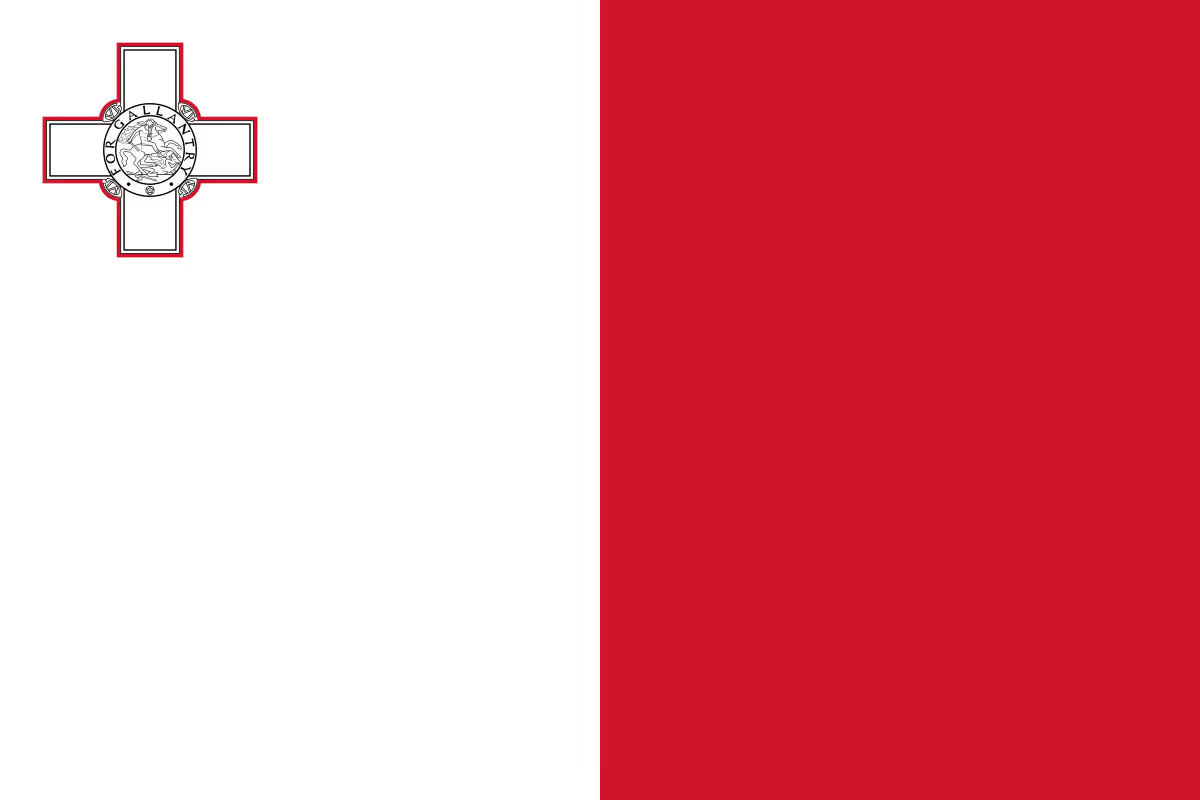




Who regulates gambling in Malta?
Gambling in Malta is regulated by the Malta Gaming Authority (MGA), the single authority for all gaming activity, established in 2001 (formerly the Lotteries and Gaming Authority), operating under the Gaming Act 2018 (Cap. 583) and the Gaming Authorisations Regulations (S.L. 583.05). Anti-money-laundering supervision sits with the Financial Intelligence Analysis Unit (FIAU). Applications are filed through the MGA Licensee Portal.
What types of Malta gaming licenses are there?
Malta uses a two-tier model: a B2C Gaming Service Licence for operators serving players, and a B2B Critical Gaming Supply Licence for suppliers serving operators. Since the 2018 reform a single licence can cover several game types, so a separate licence per game class is not required.
B2C: Gaming Service Licence (game types 1 to 4)
Type 1: games of chance played against the house, RNG-based (casino, slots, lotteries, virtual sports);
Type 2: fixed-odds betting (sportsbook);
Type 3: peer-to-peer games on commission (poker, betting exchange, bingo);
Type 4: controlled skill games (fantasy sports).
B2B: Critical Gaming Supply Licence
The B2B licence covers suppliers of gaming platforms, software or critical services to MGA-licensed (or other well-regulated EU/EEA) operators. B2B licensees are exempt from the compliance contribution and fall outside the scope of gaming tax, because they hold no Malta-player gaming revenue. A B2B licensee is also not a subject person under Malta's AML regime.
What does a Malta online casino license cover?
An online casino runs under a B2C Gaming Service Licence, Type 1 (RNG casino games such as slots, blackjack and roulette). The same licence can add Type 2 to Type 4 to combine casino, sportsbook, poker and skill games under one authorisation, valid for 10 years. This covers the remote (online) channel; land-based casino operation is licensed separately.
What are the requirements for a Malta gaming license?
A Malta gaming license requires a Maltese or EEA company with real local substance, approved key function holders, minimum share capital, and full fit-and-proper clearance of everyone behind the company. The MGA assesses people, funding and systems, not just paperwork.
- Malta or EEA company

- Local director
- Key function holders
- Minimum share capital
- Police conduct certificates
- Business plan with 3-year forecast
- Operating policies
- Source of wealth and source of funds evidence
- Player database hosted in Malta

Securing a Malta gambling license requires a registered company and compliance with Malta Gaming Authority regulations. We manage the entire application process, ensuring full adherence to KYC and AML policies while streamlining your path to licensure.
Corporate and local presence
A company incorporated in Malta or the EEA, with a registered office and genuine physical presence in Malta and a local director. The MGA conducts unannounced inspections, so a registered address without real operations is flagged.
Key function holders
The operator must appoint approved key function holders, including an MLRO / AML officer, a Data Protection Officer and a Compliance Officer (held by appropriately separate individuals), each cleared through the MGA Key Function approval. Holders carry continuous professional development obligations.
Share capital requirements
How much share capital you must hold depends on the game types you license. The amounts run from EUR 40,000 to EUR 100,000 and are cumulative for multi-type licences, capped at EUR 240,000. The table below shows the minimum for each tier.
| Game types | Minimum issued share capital |
|---|---|
| Type 1 and Type 2 | EUR 100,000 |
| Type 3, Type 4 and B2B | EUR 40,000 |
| Multiple types | Cumulative per type, capped at EUR 240,000 |
Share capital is retained in the company as a balance-sheet requirement, not a fee, and the licensee must keep a positive equity position at all times.
Fit-and-proper and documents
The MGA runs probity checks on all shareholders, directors, UBOs and key persons (criminal-record and police conduct certificates issued within the last 3 months), reviews a detailed business plan with a three-year financial forecast, and examines operating policies against its System Documentation Checklist.
Source of wealth and source of funds are assessed separately. The operator's player and transaction database must be hosted in Malta and remain accessible to the Authority (servers and other equipment may sit elsewhere).
How it works
How do you get a Malta gaming license?
Navigating the gaming license process can be complex. Here's a streamlined guide to each step.
You incorporate a Maltese company, appoint key function holders, file through the MGA Licensee Portal with a EUR 5,000 application fee, pass fit-and-proper and business reviews, complete a system audit, and receive a 10-year licence. Plan for roughly 12 months end to end.
How much does a Malta gaming license cost?
The headline regulatory costs are a EUR 5,000 application fee, a fixed annual licence fee, a compliance contribution tied to worldwide gaming revenue, and minimum share capital. The fixed fee, the compliance contribution and the share capital are three separate things and should not be added together as one number.
| Cost item | Amount | Basis |
|---|---|---|
| Application fee | EUR 5,000 | One-time, non-refundable |
| Fixed annual licence fee (B2C Types 1-3) | EUR 25,000 | Per licence, not per type |
| Fixed annual licence fee (B2C Type 4 only) | EUR 10,000 | Per licence |
| Fixed annual licence fee (B2B) | EUR 25,000 to 35,000 | Revenue-tiered (back-office providers EUR 3,000 to 5,000) |
| Compliance contribution: Type 1 | EUR 15,000 to 375,000 / year | % of worldwide GGR, paid monthly |
| Compliance contribution: Type 2 | EUR 25,000 to 600,000 / year | % of worldwide GGR, paid monthly |
| Compliance contribution: Type 3 | EUR 25,000 to 500,000 / year | % of worldwide GGR, paid monthly |
| Compliance contribution: Type 4 | EUR 5,000 to 500,000 / year | % of worldwide GGR, paid monthly |
| Minimum share capital | EUR 40,000 to 100,000 | Retained, not a fee |
| System audit | EUR 2,500 to 7,500 (B2C) / EUR 4,500 to 15,000 (B2B) | One-time, by an MGA-approved auditor |
| Licence renewal fee | EUR 5,000 | Every 10 years |
New operators get relief: qualifying start-ups receive a 12-month moratorium on the compliance contribution, and the full minimum is generally not due until a full licence period has elapsed. Fees follow the Gaming Licence Fees Regulations (S.L. 583.03), current as of 2026. For a tailored cost estimate, talk to MGL.
What taxes apply to a Malta gaming license?
A Malta operator faces three separate charges: gaming tax on Malta-player revenue only, the compliance contribution on worldwide revenue, and corporate tax. Gaming tax is currently 5% and rises on 1 October 2026.
Gaming tax on Malta-player revenue
Gaming tax applies only to revenue from players based in Malta. Until 30 September 2026 the rate is 5% for all game types. From 1 October 2026 it rises to 15% for Type 1 (casino and RNG games) and 10% for Types 2, 3 and 4, as the table shows.
| Game type | Until 30 Sep 2026 | From 1 Oct 2026 |
|---|---|---|
| Type 1 (casino/RNG) | 5% | 15% |
| Types 2, 3, 4 (betting/poker/skill) | 5% | 10% |
| Controlled premises / lawful junket | 5% | 5% |
Revenue from players outside Malta is outside the scope of gaming tax. The charge uses a residence-based test, not where the player physically is at the moment of play.
Corporate tax: 35% headline, reduced to an effective rate of about 5% through Malta's 6/7 shareholder refund on trading income. This is separate from gaming tax.
VAT: historically most remote gaming was VAT-exempt. From 1 October 2026 the exemption narrows and most B2C supplies (notably sports betting and live casino) become VAT-taxable, with a corresponding right to recover input VAT. Model the net impact before October 2026.
Important: Malta's low rates do not cover tax due elsewhere. When you serve players in another regulated market, that country taxes the revenue under its own regime (often 15% to 25% of gaming revenue), payable locally. Treat the Malta 5% as a Malta figure, not as EU-wide coverage.
Sources: Gaming Tax Regulations and Legal Notice 86 of 2026 (VAT); MGA guidance, 2026.
Does a Malta license give access to the EU market?
No, not automatically. There is no mutual recognition of gaming licences across the EU, so a Malta licence does not act as an EU passport. Markets with their own regulators (Germany, the Netherlands, France, Spain, Italy and others) require a local licence in addition.
Recent EU case law sharpened this. In the Lottoland case (Court of Justice of the EU, Case C-440/23, April 2026), the Court confirmed that an EU or MGA licence does not entitle an operator to serve players in a market where the product is banned, and that those players can bring civil claims to recover their losses. On 23 April 2026, Advocate General Emiliou stated there is no mutual recognition of gaming licences in EU law, so an MGA licence is in principle valid only in Malta, and found Malta's Bill 55 (the 2023 law shielding MGA licensees from foreign refund judgments) incompatible with EU rules on enforcing judgments. That shield is now under active legal challenge.
What the licence does give is a Tier-1, EU-regulated credential that banks, payment providers and affiliates respect, and a strong base for applying for local licences in parallel. It remains the default home jurisdiction for multi-market operators, but it is a reputation and banking advantage, not market access.
Who is the Malta license suitable for?
Malta suits scaled or well-funded operators that want a top-tier reputation, EU-grade banking and payment access, and a stable 10-year licence with an effective corporate tax rate of about 5%. It fits operators who can carry real Malta substance and meaningful compliance, and who value credibility over speed and low cost. Malta also offers a large, mature licensee ecosystem and strong support for white-label models.
What are the disadvantages of a Malta gaming license?
Malta is one of the most expensive and demanding gaming jurisdictions. The honest trade-offs:
High total cost: application fee, fixed annual fee, a compliance contribution that scales into six figures, plus setup and staffing.
Heavy ongoing compliance: annual audits, financial reporting, penetration testing and key-function CPD.
High share capital: up to EUR 100,000 retained in the company.
Strict fit-and-proper: the MGA vets every shareholder, director and UBO, and turns down applicants who fail probity or source-of-funds checks.
No EU passport: large EU markets need a separate local licence.
Litigation exposure: Bill 55, Malta's shield against foreign player-refund judgments, is under EU legal challenge (Advocate General opinion, 23 April 2026), so operators can face player restitution claims in markets that ban their product.
Real substance required: office, local staff and decision-making in Malta, verified by inspection.
Long timeline: realistically around 12 months, and longer if banking stalls.
Why choose MGL Solutions for a Malta gaming license?
MGL Solutions runs the Malta application end to end through the MGA Licensee Portal: company formation with a registered office and local director, sourcing and approval of key function holders, AML and responsible-gaming compliance frameworks, business plan and system documentation, coordination of the system audit, and support after the licence is issued. To scope your application, contact MGL.
How does Malta compare with other gaming licenses?
Malta is the high-cost, high-reputation EU option. Curacao sits in the middle, Anjouan is the cheapest and fastest, and the Isle of Man matches Malta on prestige with 0% corporate tax but a contracting operator base. Pick the licence that matches your scale and target markets.
| Parameter | Malta (MGA) | Curacao (CGA) | Anjouan (AOFA) | Isle of Man (GSC) |
|---|---|---|---|---|
| Application fee | EUR 5,000 | EUR 4,592 | from EUR 17,828 (regulator fee) | GBP 5,250 |
| Annual fee | EUR 25,000 fixed (Types 1-3) + compliance contribution | EUR 47,450 (B2C) / EUR 24,490 (B2B) | annual renewal (per licence + key person) | GBP 36,750 |
| Realistic timeline | ~12 months | 3 to 6 months | from 4 weeks (typically 6 to 8) | 5 to 9 months |
| Gaming tax | 5% on Malta-player GGR (15/10/5% from 1 Oct 2026) | 0% | 0% | 1.5% to 0.1% of GGY (tiered) |
| Corporate tax | 35% headline, ~5% effective | ~2% effective | 0% | 0% |
| Min. share capital | EUR 40,000 to 100,000 (cap 240,000) | None prescribed | None | None prescribed |
| Licence validity | 10 years | No annual expiry under LOK | 1 year (annual renewal) | 5 years |
| Reputation | Tier-1 | Established (post-LOK) | Growing | Tier-1 |
| EU / regulated-market access | No EU passport; local licence needed for DE, ES, IT, NL, FR | Broad reach; restricted list (US, FR, NL, AU and others) | Broad reach; restricted list (UK, US, DE, FR, ES, NL, AU and others) | No passport into regulated markets; strong for offshore-accepting markets |
Costs shown are regulator/government fees only and exclude company setup, staffing and professional costs. Currencies as published by each regulator. For full figures see our dedicated Curacao, Anjouan and Isle of Man pages.
FAQ
Everything you need to know about Our company. Can't find the answer you're looking for? Please chat to our team.
A Malta gaming license runs for 10 years. File the renewal with the MGA well ahead of expiry, pay the EUR 5,000 renewal fee, and pass a compliance review. MGL handles renewal for licences obtained through us.
There is no mutual recognition of gaming licences in EU law, so a Malta licence is, in principle, valid for Malta and does not cover other EU markets with their own regulators. It is widely respected as a credential and strengthens applications elsewhere, but it does not grant access to the whole EU.
No. EU law has no mutual recognition for gaming licences, and markets with their own regulators (Germany, Spain, Italy, the Netherlands and others) require a local licence.
The MGA can suspend or cancel the licence and impose administrative penalties. Criminal matters are referred to the competent authorities, and AML breaches fall under FIAU supervision.
Yes, through a company incorporated in Malta or the EEA, with a registered office, local director and genuine presence in Malta.
Type 1 and Type 2 require EUR 100,000; Type 3, Type 4 and B2B require EUR 40,000. For multiple types the requirement is cumulative, capped at EUR 240,000.
The player and transaction database must be located in Malta and accessible to the MGA. Other servers and equipment may be hosted outside Malta.
10 years (since the 2018 reform), renewable for further 10-year periods.
Yes. A registered office, a local director and approved key function holders are required, and the MGA verifies real substance through inspection.
The 35% headline corporate tax is reduced to an effective rate of about 5% through Malta's 6/7 shareholder refund on trading income. This is separate from gaming tax on Malta-player revenue.
Navigating the gaming license process can be complex. Here's a streamlined guide to each step