UK Gambling License
A UK gambling licence is the authorisation issued by the UK Gambling Commission (UKGC) to offer gambling to customers in Great Britain. It is required for online casino, betting, bingo and gambling software operators that serve the GB market, whatever country the company is registered in. The UKGC licenses and regulates gambling under the Gambling Act 2005.
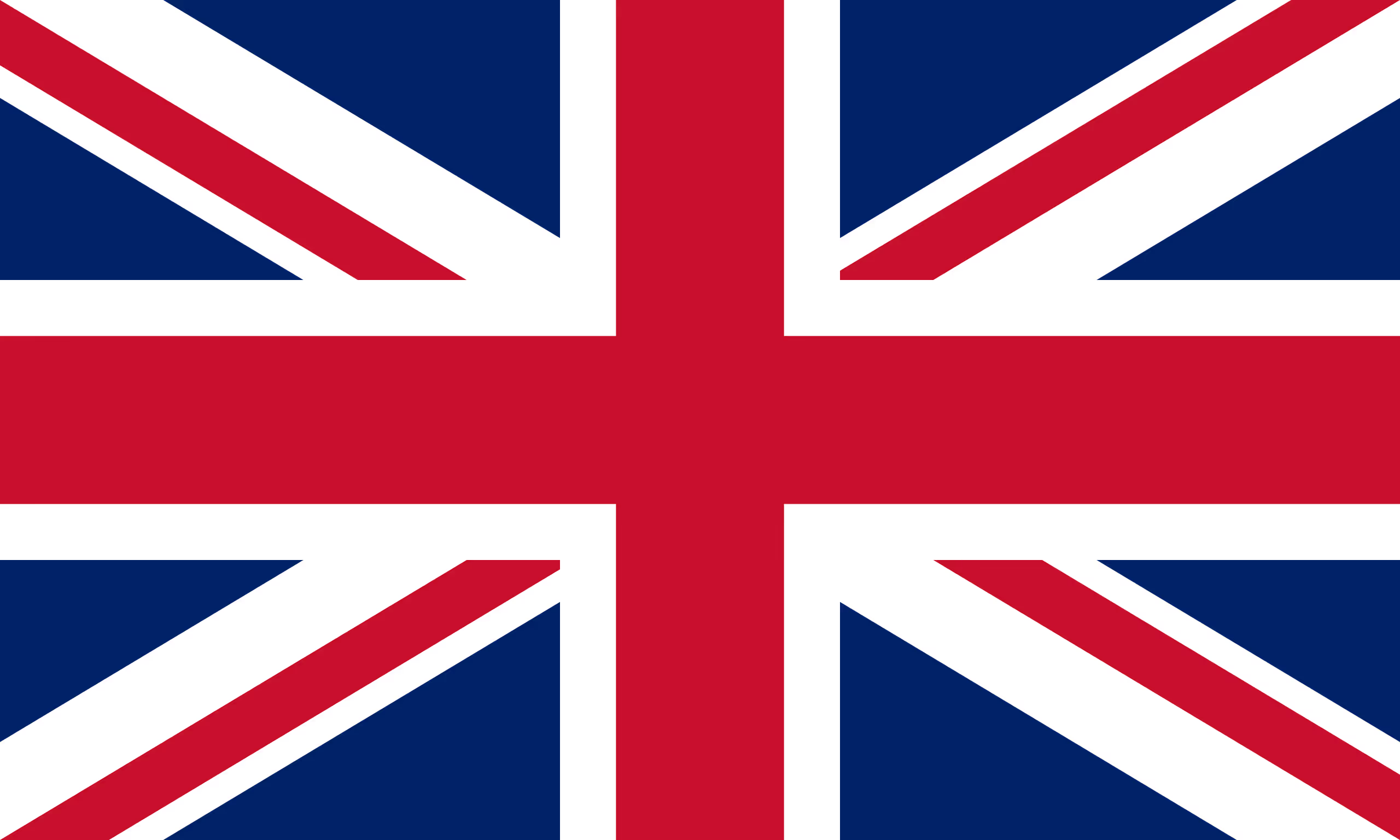




Who regulates gambling in the UK?
The UK Gambling Commission (UKGC) regulates gambling in Great Britain. The UKGC is an independent body based in Birmingham, funded by licence fees and the statutory levy. It licenses operators under the Gambling Act 2005, the Licence Conditions and Codes of Practice (LCCP) and the Proceeds of Crime Act 2002. The regime covers England, Scotland and Wales. Northern Ireland sits outside it.
The UKGC must pursue three statutory objectives: keep gambling free from crime, ensure it is fair and open, and protect children and vulnerable people.
What are the benefits of a UK gambling licence?
A UK gambling licence is the strongest credibility signal in regulated gambling. It gives operators tier-1 banking access, sterling settlement and entry to a large, mature market. UK players pay no tax on their winnings, which supports retention. The trade-off is high duty and strict compliance, covered below.
Top reputation with players, banks and software providers;
Tier-1 banking and mainstream payment access;
A large, mature Great Britain market;
No tax on player winnings.
Note: no tax on player winnings is not the same as low operator tax. Operators pay 40% Remote Gaming Duty (see the tax section).
What types of UK gambling licence are there?
The UKGC issues three families of licences. Operating licences cover each gambling activity, remote or non-remote, such as casino, betting or gambling software. Personal licences cover key individuals: the Personal Management Licence (PML) for managers and the Personal Functional Licence (PFL) for operational roles. Premises licences cover physical venues through local authorities.
There is no single iGaming licence. You license each activity you run. A typical online casino and sportsbook that supplies its own software needs three operating licences: Remote Casino, Remote General Betting Standard (Real Events), and Remote Gambling Software.
What does a UK gambling licence cover?
A UK operating licence covers the specific activities you apply for: casino, betting, bingo, gambling software, gaming machines and lotteries. Each activity is licensed separately, as remote or non-remote. Online slots carry extra rules, including stake limits. The National Lottery is licensed separately.
| Activity | Remote or non-remote | Separate licence |
|---|---|---|
| Casino | Both | Yes |
| Betting (real events) | Both | Yes |
| Bingo | Both | Yes |
| Gambling software | Both | Yes |
| Gaming machines | Non-remote | Yes |
| Lotteries (society) | Both | Yes |
Who needs a UK gambling licence?
Anyone offering gambling to customers in Great Britain needs a UKGC licence, whatever country the company is registered in. Under the 2014 point-of-consumption rules, an offshore operator that accepts GB players must hold a UKGC operating licence. The test is where the customers are, not where the operator sits.
How it works
How do you get a UK gambling licence?
Navigating the gaming license process can be complex. Here's a streamlined guide to each step.
To get a UK gambling licence, you set up the holding company, prepare ownership and source-of-funds evidence, then apply to the UKGC for the operating licences you need alongside Personal Management Licences for key individuals. The UKGC then assesses suitability and technical standards. The published target is about 16 weeks for a complete application.
What are the requirements for a UK gambling licence?
A UK gambling licence requires full corporate transparency. Every controller with 10% or more ownership is personally assessed, and every 3% shareholder is listed. Key managers must hold Personal Management Licences. The operator must prove legitimate source of funds, a working AML and KYC programme, technical certification against the RTS, and responsible-gambling controls.
- Corporate transparency and disclosed UBOs

- Personal Management Licences for key managers
- Legitimate, evidenced source of funds
- AML and KYC programme
- Technical certification against the RTS
- Responsible-gambling controls

To secure a gambling license in the United Kingdom, operators must be registered with the UK Gambling Commission, provide financial records, and outline a clear business plan. While you focus on these essentials, we take care of the application process, establish KYC and AML procedures, and ensure full compliance with UK regulations, streamlining your path to licensure.
How much does a UK gambling licence cost?
UK gambling licence fees are not fixed. The application fee and the annual fee scale with the activity and your Gross Gambling Yield (GGY) band, and each operating licence is charged separately. A licence fee is separate from duty and from the statutory levy. Confirm exact figures with the UKGC fee calculator.
| Item | Amount |
|---|---|
| Remote Casino application fee (entry band) | £4,224 |
| Remote Casino annual fee (entry band) | £4,199 |
| Remote Betting (Real Events) application fee (entry band) | £4,693 |
| Statutory levy (remote operators) | 0.1% to 1.1% of GGY; 1.1% remote |
Fees rise steeply across higher GGY bands. Each activity is charged in full, because the multiple-licence discount was abolished in 2021.
What taxes apply to a UK gambling licence?
UK gambling tax falls on the operator, not the player. Under point-of-consumption rules since 2014, duty applies wherever the operator is based. Remote Gaming Duty rose from 21% to 40% of GGY on 1 April 2026. General Betting Duty rises to 25% on remote betting from 1 April 2027 (UK horse-racing stays at 15%), and Bingo Duty is abolished. Player winnings are not taxed.
Remote Gaming Duty and Corporation Tax stack. A UK-facing online casino pays 40% of gross gaming yield before Corporation Tax on the remaining profit.
What recent reforms affect UK gambling licensees?
The 2023 White Paper, "High stakes: gambling reform for the digital age", is reshaping the UK market. Online slot stakes are now capped, a statutory levy applies to all licensees, and financial-risk checks on higher-spending customers are being introduced. These reforms change operating costs and margins.
Online slot stake limit, players aged 25 and over: £5 per spin, from 9 April 2025;
Online slot stake limit, players aged 18 to 24: £2 per spin, from 21 May 2025;
Statutory levy: 0.1% to 1.1% of GGY; remote operators pay 1.1%, from 6 April 2025;
Financial-risk checks on higher-spending customers: being introduced.
How long does it take to get a UK gambling licence?
The UK Gambling Commission targets about 16 weeks to process a complete application. A clean, transparently owned applicant can reach 10 to 16 weeks. A complex corporate chain, offshore ownership or source-of-funds questions can extend this to six months or more. Incomplete applications and information requests cause most of the delay.
How long is a UK gambling licence valid, and how is it renewed?
A UK gambling licence has no fixed expiry date. Operating and personal licences stay valid as long as the operator pays the annual fee before each anniversary and complies with the LCCP. There is no renewal re-application. Maintaining a licence means paying on time and staying compliant. Personal licences carry a five-yearly maintenance fee.
Is a UK gambling licence valid in the EU?
No. A UKGC licence authorises gambling for the Great Britain market only, meaning England, Scotland and Wales. The UK has left the EU, so a UK licence does not grant access to EU member states, which run their own national licensing regimes. The value of a UK licence is reputation and access to the GB market.
What are the disadvantages of a UK gambling licence?
The main drawbacks of a UK gambling licence are cost and control. Remote Gaming Duty is 40% of GGY from 1 April 2026, compliance is strict and actively enforced, and stake limits and the statutory levy compress margins. The licence is expensive and slow to obtain, and it covers Great Britain only.
High duty: 40% Remote Gaming Duty on gaming GGY;
Strict, interventionist compliance under the LCCP;
Stake limits and statutory levy that pressure margins;
Expensive and slow, with PMLs required for key individuals;
Great Britain market only, with no EU passport;
Large penalties for breaches.
How does the UK compare with other gambling licences?
The UK offers the highest prestige and a large market, but the highest duty and the strictest compliance. Malta offers an EU-member-state licence and a ~5% effective corporate tax. The Isle of Man pairs a respected regime with a low gaming duty. Curaçao is the cheapest and fastest route, with a weaker reputation since its 2024 reform.
| Jurisdiction | Regulator | Headline tax on online gaming | Review time | Licence validity | Market and reputation |
|---|---|---|---|---|---|
| United Kingdom | UKGC | 40% Remote Gaming Duty on GGY, from 1 April 2026 | About 16 weeks, 6+ months if complex | No fixed expiry, annual fee | Great Britain only, top prestige, tier-1 banking |
| Malta | MGA | 5% effective corporate tax; gaming tax only on Malta-player revenue (5%, rising to 15% casino and 10% other from 1 October 2026); plus compliance contribution on worldwide GGR | About 12 months realistic (8 to 20) | 10 years | EU-member-state licence, strong reputation |
| Isle of Man | GSC | 1.5% on the first £20m GGY, 0.5% on the next £20m, 0.1% above £40m | 3 to 4 months | 5 years | Respected, English-speaking, good banking |
| Curaçao | CGA | 2% (E-Zone) for most operators; 15% only for groups above €750m revenue | About 8 weeks per phase | Under the LOK framework, in force 24 December 2024 | Cheapest and fastest, weaker reputation |
These tax rates are not directly comparable, because the base differs. The UK 40% applies to all gaming GGY from UK players and cannot be structured away. Malta's 5% is corporate tax after the refund system, and its gaming tax applies only to Malta-resident players, so for an internationally facing operator the main variable cost is the compliance contribution on worldwide revenue. The Isle of Man and Curaçao rates are low by design.
Why choose MGL for a UK gambling licence?
MGL guides operators through the full UKGC process: company structuring, controllers and Personal Management Licence holders, the AML and responsible-gambling framework, technical certification, the statutory levy and regulatory returns. We prepare source-of-funds evidence to UKGC standard and manage the operating and personal licence applications together.
- 1
UKGC operating and PML applications handled together
- 2
AML, KYC and RTS readiness built in
- 3
Source-of-funds evidence prepared to UKGC standard
- 4
Support with the statutory levy and regulatory returns
- 5
Clear, defined scope of work
FAQ
Everything you need to know about Our company. Can't find the answer you're looking for? Please chat to our team.
A UK gambling licence is UKGC authorisation to offer gambling to customers in Great Britain. It is required for online casino, betting, bingo and gambling software operators serving the GB market, whatever country the company is registered in.
Yes. Any operator offering gambling to customers in Great Britain needs a UKGC licence, whatever country it is registered in. This follows the 2014 point-of-consumption rules.
No. Players in the UK pay no tax on gambling winnings. The tax sits with the operator, mainly through Remote Gaming Duty.
Remote Gaming Duty rose from 21% to 40% of gross gaming yield on 1 April 2026 and is in force now. Confirm current rates with HMRC.
The UKGC targets about 16 weeks for a complete application. Complex or offshore cases often take six months or more. There is no formal fast-track.
Licensees file regulatory returns with the UKGC, typically quarterly or annually by licence type, plus key-event reports on significant changes such as control, key personnel or banking.
The UKGC can open investigations, impose financial penalties, attach conditions, and suspend or revoke a licence. Recent penalties include William Hill at £19.2m in 2023 and Entain at £17m in 2022.
No. Operating licences cannot be transferred. A change of corporate control triggers UKGC notification within five working days and a fresh suitability assessment of the new owners.
Beyond licence fees, expect the statutory levy (0.1% to 1.1% of GGY; remote operators pay 1.1%), RTS technical testing, AML systems, PML holders and responsible-gambling tooling. These are separate from duty.
Navigating the gaming license process can be complex. Here's a streamlined guide to each step