Alderney Gaming License
An Alderney gambling license is a remote gambling authorisation issued by the Alderney Gambling Control Commission under the Alderney eGambling Ordinance, 2009. The license covers player-facing operators as Category 1 and platform suppliers as Category 2. Annual fees run from £35,000 to £400,000 by net gaming yield, and approval takes 4 to 12 weeks.
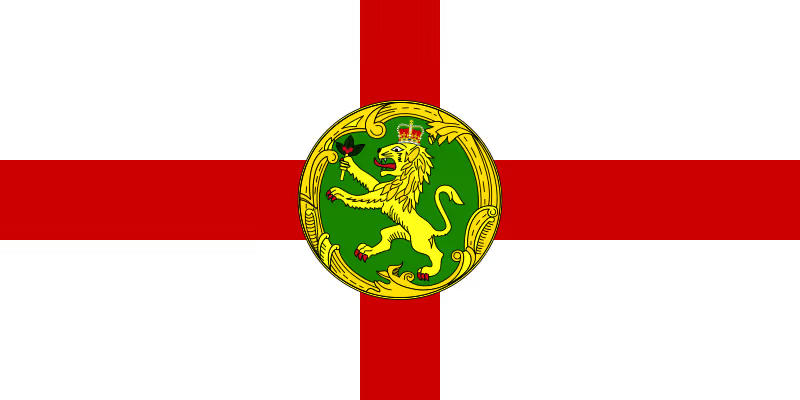





Key facts
| Regulator | Alderney Gambling Control Commission (AGCC), established 2000 |
|---|---|
| Legal basis | The Gambling (Alderney) Law, 1999, as amended; Alderney eGambling Ordinance, 2009; Alderney eGambling Regulations, 2009; Amendment Ordinances 2024 and 2025 |
| Authorisation types | Category 1 license (B2C), Category 2 license (B2B), Category 1 and Category 2 Associate Certificates, Core Services Associate Certificate, Temporary license, Hosting certificate |
| Tax on licensed activity in Alderney | 0 percent. No gaming duty, no value added tax, no corporate income tax, no capital gains tax |
| First-year fee, Category 1 or Category 2 | £17,500 for the first year where the applicant holds no previous Alderney license in that category; otherwise £35,000 |
| Annual fee | Category 1: £35,000 to £400,000 by net gaming yield band. Category 2: £35,000 |
| Investigation deposit | £10,000 for a Category 1 or Category 2 license or Associate Certificate; £5,000 for a Core Services Associate Certificate |
| License term | No fixed expiry. Annual fees fall due by net gaming yield band |
| Timeline | 4 to 12 weeks, and as little as four weeks on a complete file |
| Local presence | No physical presence required. Servers may sit in an approved off-island cloud or data centre, except certain Category 2 platform functions, which must run on servers in the Bailiwick of Guernsey, of which Alderney is part. An Alderney company needs a resident agent and registered office; a Category 1 Associate Certificate needs a resident representative |
| EU market access | None. Alderney is a British Crown Dependency outside the EEA. Taking deposits from players in Great Britain needs a separate UK Gambling Commission license |
Alderney regulates remote gambling through the Alderney Gambling Control Commission, which authorises operators under the Alderney eGambling Ordinance, 2009. Category 1 covers businesses that register players, verify them and hold their money. Category 2 covers businesses that run the gaming platform. A Category 1 license covers player-facing products such as online casino, live dealer, sports betting and poker. Foreign companies can hold Alderney regulation through an Associate Certificate without incorporating on the island.
Who is the Alderney Gambling Control Commission (AGCC)?
The Alderney Gambling Control Commission is the statutory regulator for remote gambling in Alderney, established in 2000 under The Gambling (Alderney) Law, 1999. The AGCC licenses operators under the Alderney eGambling Ordinance, 2009 and the Alderney eGambling Regulations, 2009. The commission is independent of the UK Gambling Commission.
The legal framework has moved twice recently. The Alderney eGambling (Amendment) Ordinance 2024 added Schedule 5 to the 2009 Ordinance, formalising the AGCC information gathering and sharing powers. The Alderney eGambling (Amendment) Ordinance 2025 took effect on 1 January 2026.
The AGCC assesses the finances, technical capability and integrity of applicants, sets standards for gaming equipment, enforces anti-money laundering rules and audits license holders. The Director, Regulatory Operations arranges a meeting with the applicant to review the planned games, activities and technical setup.
What types of Alderney licenses and certificates are there?
The AGCC issues two licenses and four supporting authorisations. A Category 1 license covers player registration, verification and player funds. A Category 2 license covers platform operation. Associate Certificates regulate foreign companies without an Alderney company, and Core Services, Temporary and Hosting authorisations cover narrower roles.
| Category 1 eGambling license (B2C) | Operators that register and verify players and hold player funds |
|---|---|
| Category 2 eGambling license (B2B) | Suppliers that operate the gaming platform |
| Category 1 Associate Certificate | Foreign B2C operators without an Alderney company |
| Category 2 Associate Certificate | Foreign B2B suppliers without an Alderney company |
| Core Services Associate Certificate (CSAC) | Third parties supplying software, deposit handling or management services |
| Temporary eGambling license | Operators licensed elsewhere, for market testing or disaster recovery. Limited to 29 consecutive days, or 59 days in any six months |
| Hosting certificate | Approved data centres hosting licensed operators |
Do you need an Alderney company or local presence?
Alderney requires no physical presence in the Bailiwick for any license or certificate holder. Category 1 and Category 2 licenses are held by Alderney-registered companies, and foreign companies use an Associate Certificate instead. Servers may sit in an approved off-island cloud or data centre, except certain Category 2 platform functions, which must run on Bailiwick servers.
The choice between the two routes is a cost decision, not a compliance one. An Alderney company keeps the annual fee at the license rate. An Associate Certificate removes the incorporation step and raises the annual fee to £50,000. Neither route is entirely presence-free: an Alderney company needs a resident agent and a registered office, and a Category 1 Associate Certificate needs a resident representative.
How it works
How do you get an Alderney gambling license?
Navigating the gaming license process can be complex. Here's a streamlined guide to each step.
Applying for an Alderney gambling license runs through five stages: forming the license holder, filing the application with an investigation deposit, due diligence on the business and its key people, systems testing, and approval to start trading. The AGCC issues a license in 4 to 12 weeks, and in as little as four weeks on a complete file.
What are the requirements for an Alderney license?
An Alderney gambling license requires a license holder company, named responsible people, tested systems and documented player protection. The AGCC looks for an executive director and a money laundering reporting officer. Certified random number generators, identity checks before play, segregated player funds and financial capacity matched to the operation complete the file.
What the AGCC expects in the file:
An Alderney-registered company for a Category 1 or Category 2 license, or an Associate Certificate application for a foreign company.
An executive director and a money laundering reporting officer, both named and vetted.
Certified random number generators and independently tested game fairness.
Documented internal control systems covering operations, finance and player data.
Verify Before Play: age and identity verification completed before a player deposits or bets.
Player funds held separately from operating funds.
Anti-money laundering, know your customer and data protection policies, with customer due diligence triggered at a first deposit of €3,000.
Capitalisation under Regulation 243: cash above player balances, current assets above current liabilities, and total assets exceeding total liabilities by at least 25 percent.
How much does an Alderney gambling license cost?
Alderney gambling license fees are set by the AGCC and published in its fee schedule. A Category 1 or Category 2 license costs £17,500 for the first year where the applicant holds no previous Alderney license in that category, and £35,000 otherwise. Category 1 renewals then run from £35,000 to £400,000 by net gaming yield.
Fees by authorisation, from the AGCC schedule:
| Authorisation | First year | Then annually |
|---|---|---|
| Category 1 eGambling license | £17,500 where the applicant holds no previous Alderney license in this category, otherwise £35,000 | £35,000 to £400,000 by net gaming yield band |
| Category 2 eGambling license | £17,500 on the same condition, otherwise £35,000 | £35,000 |
| Category 1 Associate Certificate | £35,000 | £50,000, to a maximum of £450,000 |
| Category 2 Associate Certificate | £35,000 | £50,000 |
| Core Services Associate Certificate | £10,000 | £10,000 |
| Temporary eGambling license | £10,000 | £10,000 |
| Hosting certificate | Nil | Nil |
| Investigation deposit | £10,000 for a Category 1 or Category 2 license or Associate Certificate, £5,000 for a Core Services Associate Certificate | Not recurring |
| Gambling business associate | £3,000 per associate | £3,000 per associate |
Category 1 annual fees are banded by net gaming yield (NGY), to a maximum of £400,000:
| Band A, under £500,000 | £35,000 |
|---|---|
| Band B, £500,000 to under £1m | £60,000 |
| Band C, £1m to under £5m | £80,000 |
| Band D, £5m to under £7.5m | £130,000 |
| Band E, £7.5m to under £20m | £200,000 |
| Band F, £20m to under £30m | £290,000 |
| Band G, £30m and above | £400,000 |
The fee schedule is not the whole cost. Budget also for the £10,000 investigation deposit, a £5,000 deposit for approval of gambling equipment, the annual gambling business associate fee of £3,000 per associate, company formation, and legal and compliance support. Deposits are drawn down against time spent at published hourly rates, and any balance is refunded.
What taxes apply to an Alderney gambling license?
Alderney charges no gaming duty on gross gaming yield, no value added tax, no corporate income tax and no capital gains tax on licensed gambling activity. Tax still follows the markets an operator serves: British players require a UK Gambling Commission license and UK Remote Gaming Duty, now 40 percent of remote gaming profits.
Treat the 0 percent rate as a statement about Alderney, not about an operator's total tax bill. An operator's real rate depends on where its players are, where its people sit and where its revenue is booked. UK Remote Gaming Duty rose from 21 percent to 40 percent for accounting periods beginning on or after 1 April 2026.
What are the advantages of an Alderney gambling license?
An Alderney gambling license carries regulatory standing that offshore licenses rarely match, and it costs nothing in local tax. Banks and payment partners treat AGCC regulation as a strong signal. Approval runs 4 to 12 weeks, and Associate Certificates let a foreign operator hold Alderney regulation without incorporating on the island.
What the license gives you:
A regulator active since 2000, recognised across the industry.
No gaming duty, value added tax, corporate income tax or capital gains tax in Alderney.
Standing that helps in banking and payment provider onboarding.
A route for foreign companies through Associate Certificates, with no Alderney incorporation.
Alderney requires no physical presence in the Bailiwick and allows off-island cloud hosting for most functions.
Approval in 4 to 12 weeks on a complete application.
What are the disadvantages of an Alderney gambling license?
An Alderney gambling license is a premium product, not a cheap route to market. First-year fees start at £17,500, the annual fee reaches £35,000 from year two and rises with net gaming yield, and a £10,000 investigation deposit is spent whatever the outcome. The license gives no EU market access.
What to weigh before applying:
Entry cost sits well above entry-level offshore jurisdictions.
Annual fees scale with net gaming yield, reaching £400,000 in the top band.
An investigation deposit of £10,000 is spent on the review whatever the outcome.
Systems, random number generator and internal control testing add cost and time.
No EU passporting, and no mutual recognition with EU regulators.
British players require a separate UK Gambling Commission license.
Compliance load is continuous: audits, reporting and annual renewal.
Why choose MGL Solutions for Alderney licensing?
MGL Solutions runs the Alderney application end to end. We form the license holder or advise the Associate Certificate route. We prepare the AGCC application and the due diligence file, coordinate systems testing and hosting, and build the anti-money laundering and player protection framework. We have obtained 300+ licenses for clients.
What we handle:
We price both routes against your revenue plan: Alderney company or Associate Certificate.
We form the Alderney company and appoint your executive director and money laundering reporting officer.
We prepare the AGCC application file and the due diligence pack on your directors and beneficial owners.
We coordinate random number generator certification, game fairness testing and the internal control system.
Hosting goes to an approved data centre, inside or outside the Bailiwick.
We write your anti-money laundering, know your customer, player fund protection and data protection policies.
After approval, we handle annual renewal, net gaming yield reporting and fee band management.
If Alderney turns out to be the wrong fit for your model, we license across offshore, onshore and EU tier-1 markets. Tell us how you plan to operate and which markets you are targeting, and we will tell you whether Alderney is the right jurisdiction. Book a consultation.
How does Alderney compare with other gaming licenses?
Alderney sits in the premium tier alongside the Isle of Man, and it is priced there. Compared with Curaçao or Anjouan, Alderney costs more, asks more and returns more regulatory standing. Compared with Malta, Alderney is cheaper to enter but carries no EU market access at all.
| Jurisdiction | Tier | Gaming tax | Regulator fees, year one | Local company | EU or EEA access | Timeline |
|---|---|---|---|---|---|---|
| Alderney | Premium reputational | 0 percent in Alderney | £17,500 introductory Category 1 or Category 2 fee, plus a £10,000 investigation deposit | Alderney company for a license, none for an Associate Certificate | No, outside the EEA | 4 to 12 weeks |
| Isle of Man | Premium reputational | Gambling duty 1.5 percent of gaming yield to £20m, 0.5 percent to £40m, 0.1 percent above | £5,250 application, £36,750 a year for a Full OGRA license | Isle of Man company, two resident directors, island office | No, outside the EEA | 5 to 9 months, GSC review 10 to 12 weeks |
| Malta | Tier 1 EU | 5 percent gaming tax on Maltese revenue, rising to 15 percent for Type 1 and 10 percent for Types 2 to 4 on 1 October 2026 | €5,000 application, €25,000 a year B2C, plus a compliance contribution from €15,000 | Malta company | Yes, EU member state | About 12 months |
| Curaçao | Recognised offshore | 0 percent gaming tax | €4,592 application, €47,450 a year B2C | Curaçao company, office and a resident key person | No, outside the EEA | 3 to 6 months |
| Anjouan | Entry-level offshore | 0 percent gaming tax | From €17,828 government fee | None | No | From 4 weeks, typically 6 to 8 |
We checked every figure above against the regulator in August 2026. Fee levels and timelines move with each regulator's reform cycle. Compare the current position on our gambling license hub, or on the Malta, Isle of Man, Curaçao and Anjouan pages.
FAQ
Everything you need to know about Our company. Can't find the answer you're looking for? Please chat to our team.
No. The Alderney Gambling Control Commission is independent of the UK Gambling Commission. The UK white list closed under the Gambling (Licensing and Advertising) Act 2014, so serving Great Britain needs a UK Gambling Commission license. UK advertising follows the ASA and CAP codes.
A Category 1 or Category 2 Alderney license is held by an Alderney-registered company, which needs a resident agent and registered office. Foreign operators keeping their existing company use an Associate Certificate, which needs a resident representative for Category 1. Neither route requires physical staff or premises in Alderney.
An Alderney Temporary eGambling license lets an operator licensed in another jurisdiction run Alderney-regulated activity for 29 consecutive days, or 59 days in any six months, for market testing or disaster recovery. The AGCC fee schedule sets the fee at £10,000 a year.
The AGCC states that an Alderney eGambling license takes 4 to 12 weeks, and can be issued in as little as four weeks where the applicant is suitable and the documentation is complete. Due diligence response times drive the difference.
Alderney charges no gaming duty, value added tax, corporate income tax or capital gains tax on licensed gambling activity. Taxes in the markets an operator serves still apply: UK players attract UK Remote Gaming Duty at 40 percent. An Alderney license removes local tax, not tax everywhere.
No. Alderney is a British Crown Dependency within the Bailiwick of Guernsey and sits outside the EEA, so an Alderney gambling license carries no EU passporting or mutual recognition. AGCC standing helps with banking and payment partners, which is not market access.
The Alderney eGambling (Amendment) Ordinance 2025 took effect on 1 January 2026. The ordinance defines promotion for Category 1 licensing, standardises the customer due diligence trigger at a first deposit of €3,000, replaces the Schedule 1 application form, and makes submission fully digital.
The AGCC route runs 4 to 12 weeks, and the choice between an Alderney company and an Associate Certificate is a cost decision worth getting right. MGL Solutions runs the application end to end — from the license holder to systems testing and approval.