State of Georgia Gaming License
The U.S. state of Georgia issues no casino, online gambling or sports betting license. The Georgia Constitution bans casino gambling and pari-mutuel betting. Only three legal forms exist: coin operated amusement machines licensed by the Georgia Lottery Corporation (GLC), lottery retailer contracts, and charitable bingo and raffles operated by nonprofits.
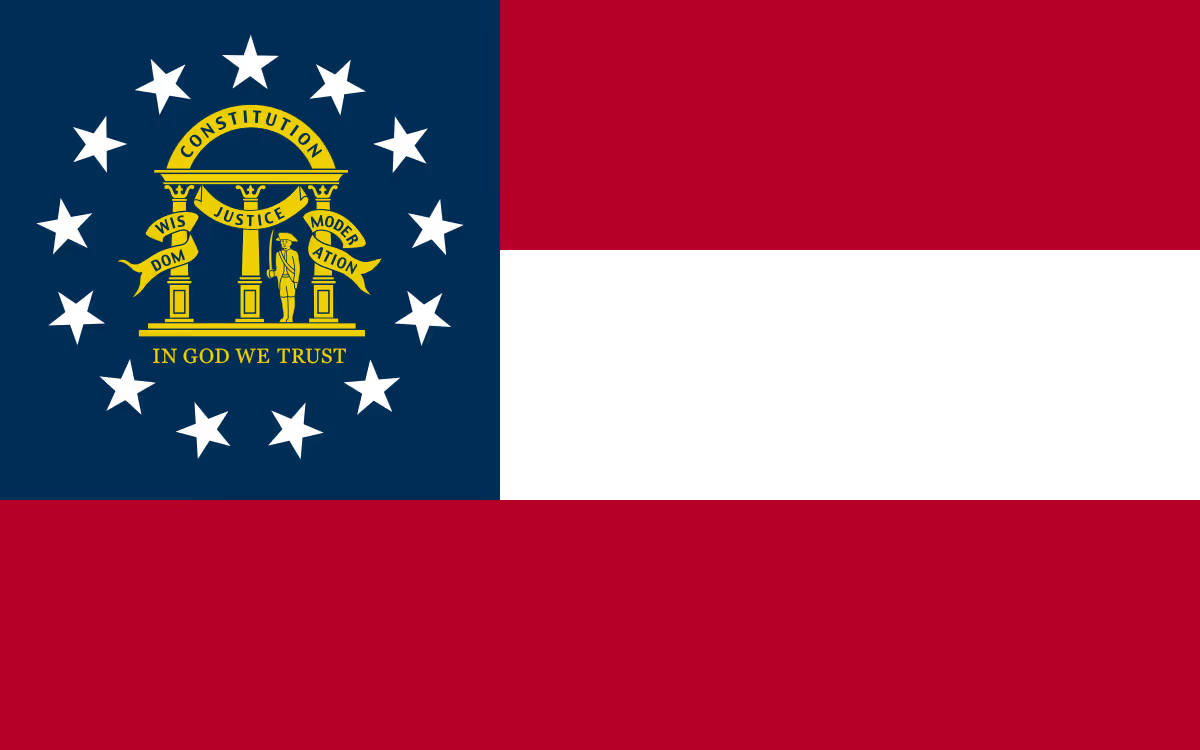





Georgia the U.S. state and Georgia the country are two different jurisdictions with two different regulators. This page covers Georgia, USA. Looking for the country of Georgia? See our Georgia (country) gaming license page at https://www.mygaminglicense.com/license/georgia.
Key facts
| Legal gambling in Georgia | Georgia Lottery, coin operated amusement machines (Class A and Class B), charitable bingo, charitable raffles |
|---|---|
| Not legal in Georgia | Commercial casinos, tribal casinos, online casino and iGaming, sports betting, pari-mutuel betting |
| Regulator, lottery and COAM | Georgia Lottery Corporation |
| Regulator, criminal enforcement | Georgia Bureau of Investigation, Commercial Gambling Unit |
| Regulator, bingo | Georgia Secretary of State, since 1 July 2021 |
| Regulator, raffles | County sheriff |
| Legal basis | Ga. Const. Art. I, Sec. II, Para. VIII; Official Code of Georgia Annotated (O.C.G.A.) Sections 16-12-21 and 16-12-22; O.C.G.A. Title 50, Chapter 27 |
| Class B COAM net receipts | Georgia Lottery Corporation 13 percent, location owner or operator 43.5 percent, master licensee 43.5 percent (Georgia Code Section 50-27-102) |
| Route to any expansion | Constitutional amendment: two-thirds of both chambers plus a statewide referendum |
What gambling licenses does the U.S. state of Georgia issue?
The U.S. state of Georgia issues three gambling authorizations: a coin operated amusement machine (COAM) license from the Georgia Lottery Corporation, a lottery retailer contract from the same corporation, and charitable bingo or raffle licenses for nonprofits. No casino, online casino, iGaming or sports betting license exists in Georgia.
None of these is an operator license in the sense used offshore. A Georgia (U.S.) COAM license covers physical amusement machines in a venue, not an online gaming platform. Operators who need a remote license for online play should compare offshore and EU routes on our gambling license hub at https://www.mygaminglicense.com/license.
| License | Regulator | Who can hold it | Fee |
|---|---|---|---|
| COAM master license | Georgia Lottery Corporation | Owner of machines placed for public play | Annual: Class A $500 to $3,500 by machine count; Class B $5,000 |
| COAM location license | Georgia Lottery Corporation | Business where the machines stand | Annual: $25 per Class A machine; $125 per Class B machine |
| Lottery retailer contract | Georgia Lottery Corporation | Retail business selling lottery products | $125 application fee, one time |
| Charitable bingo license | Georgia Secretary of State | Nonprofit tax-exempt organization, 12 months in existence | $100 a year |
| Charitable raffle license | County sheriff | Nonprofit 501(c), church, school or civic organization, 24 months in existence | Up to $100 a year |
COAM licenses (Class A and Class B)
Coin operated amusement machines fall under the Georgia Lottery Corporation, which splits them into two statutory classes. Class A machines are bona fide amusement machines that reward the player with noncash merchandise, prizes, toys or gift cards. Class B machines let a successful player accrue points and carry them over to later plays.
Class A COAM redemption per play cannot exceed a wholesale value of $50.00, a cap written into the Class A definition at Georgia Code Section 50-27-70. Class B redemption is restricted to replays, lottery products and gift cards under Georgia Code Section 50-27-71.1, and this restriction tightened on 1 July 2026.
Lottery retailer license
A lottery retailer contract lets a retail business sell Georgia Lottery products. The Georgia Lottery Corporation charges a $125 non-refundable application fee once and reviews the applicant's tax standing, criminal record, credit history and premises security under Georgia Code Section 50-27-17. A retailer contract runs for one year from issue and is separate from any COAM license.
Charitable bingo and raffle registration
Charitable gaming in Georgia is open only to nonprofit tax-exempt organizations, and two different authorities license it. The Georgia Secretary of State has regulated bingo since 1 July 2021, when the General Assembly moved that authority away from the Georgia Bureau of Investigation. County sheriffs license raffles under Georgia Code Section 16-12-22.1.
Neither license authorizes commercial gambling in Georgia. A bingo applicant must have existed for 12 months, pays $100 annually, and holds a license that expires on 31 December. A raffle applicant must have existed for 24 months and pays an annual fee that the statute caps at $100.
Is there a casino, online, or sports betting license in the U.S. state of Georgia?
No. Ga. Const. Art. I, Sec. II, Para. VIII prohibits all lotteries, the sale of lottery tickets, all forms of pari-mutuel betting and casino gambling, and directs that penal laws enforce the ban. The article carves out only nonprofit bingo and a lottery operated by or on behalf of the state.
Searches for a Georgia state casino license or a Georgia online gambling license describe a product that does not exist. There is no application form, no fee schedule and no regulator to apply to, because the prohibition sits in the constitution rather than in a statute the legislature could simply amend.
Widening the market requires a constitutional amendment. That means a two-thirds vote in both chambers of the General Assembly followed by approval at a statewide referendum.
Who regulates gambling in the U.S. state of Georgia?
Four authorities divide gambling oversight in the U.S. state of Georgia. The Georgia Lottery Corporation runs the state lottery and licenses coin operated amusement machines. The Georgia Bureau of Investigation (GBI) Commercial Gambling Unit handles criminal enforcement. The Georgia Secretary of State licenses bingo, and county sheriffs license raffles.
No agency in Georgia licenses casinos, online casinos or sportsbooks, because no such license exists in state law. Georgia gaming regulations reach only the lottery, coin operated amusement machines and charitable gaming. The Georgia Lottery Corporation would gain that role only if the General Assembly passed a bill such as HB 910, which died in the 2026 session.
What are Georgia (U.S.) COAM licenses and how do you get one?
COAM licensing is the one real B2B route in the U.S. state of Georgia. The Georgia Lottery Corporation issues two licenses that work together: a master license held by the party that owns the machines, and a location license held by the business where the machines stand. Manufacturers and distributors hold separate licenses.
Fees are set by statute in Georgia Code Section 50-27-71 and do not vary by processing speed.
| COAM license type | Annual fee (Georgia Code Section 50-27-71) |
|---|---|
| Class A master, 5 or fewer machines | $500 |
| Class A master, 6 to 60 machines | $2,000 |
| Class A master, 61 or more machines | $3,500 |
| Class B master, any number of machines | $5,000 |
| Location license, per Class A machine | $25 |
| Location license, per Class B machine | $125 |
| Distributor license | $5,000 |
| Manufacturer license | $5,000 |
| Late renewal, filed after due date before expiry | $1,000; $100 for Class A master and location licenses |
Applicants undergo background and financial review by the Georgia Lottery Corporation. A renewal filed after the published due date but before expiry carries a $1,000 late fee, reduced to $100 for Class A master and location licenses. A license expired for more than 90 days cannot be renewed at all.
Each application or renewal also carries a $100 administrative and payment-processing fee. Licenses run on a cycle from 1 July to 30 June, and since HB 353 an applicant may take a one, two or three year license by paying the annual fee multiplied by the term.
Master license vs location license
A master license belongs to the operator that owns coin operated amusement machines and places them in businesses for public play. A location license belongs to the venue where those machines sit, and it is priced per machine rather than as a flat fee.
Class B master licenses are capped at 220 under Georgia Code Section 50-27-73 and awarded by competitive auction. The corporation must auction at least one license every three years, and anyone already holding a Class B master license when that rule took effect is exempt from the auction.
The two roles carry different money. Under Georgia Code Section 50-27-102 the Georgia Lottery Corporation retains 13 percent of Class B net receipts, the location owner or operator receives 43.5 percent, and the Class B master licensee receives 43.5 percent.
Under Georgia Code Section 50-27-84 a location owner may not derive more than 50 percent of quarterly gross retail receipts at that location from Class B machines, and may not offer more than nine Class B machines for public play in one location. Class B location license holders must also keep a separate electronic funds transfer account for the state share.
HB 353 and the cash-payout ban
HB 353, passed in 2024, is the compliance fact that decides whether a Georgia COAM operation is legal or criminal. Cash payouts are prohibited. Since 1 July 2026, the only lawful Class B redemptions are replays, lottery products and gift cards, whether nonreloadable or reloadable, and Georgia Code Section 50-27-71.1 states that no other form of redemption is allowed.
Merchandise and fuel are no longer standalone redemption forms for Class B machines, and now reach the player only through a gift card. A gift card may be loaded only on the premises of the location licensee, by that licensee, its employees or a self-service redemption device on those premises. The player may spend it off the premises, but it may not be exchanged for cash, change or currency.
A location owner that redeems anything other than replays or lottery products outside a gift card receives a warning for a first violation and civil penalties after that. Class A machines may redeem through replays and gift cards, subject to the $50.00 wholesale cap per play.
How do charitable bingo and raffle licenses work in the U.S. state of Georgia?
Only registered nonprofits may run charitable gaming in Georgia. Bingo licensing sits with the Georgia Secretary of State and costs $100 a year, and the organization must have existed for 12 months. Raffle licensing sits with the county sheriff, costs up to $100 a year, and requires 24 months of existence.
Eligible bodies include tax-exempt churches, schools and civic organizations, nonprofits qualified under Section 501(c) of the Internal Revenue Code, and other bona fide nonprofits the sheriff approves. A sheriff may also issue a special limited license covering up to three raffles in a calendar year, with the fee and the annual report waived.
Prize limits and the use of proceeds are both capped. Bingo prizes may not exceed $1,500 in cash or gifts of equivalent value in any calendar day, or $3,000 in any calendar week, under Georgia Rule 92-2-.21 and Georgia Code Section 16-12-60. A licensed organization must use its bingo proceeds solely within Georgia.
Charitable gaming carries no route into commercial gambling. A nonprofit bingo license does not authorize casino games, machines or betting.
What is the status of sports betting and casino legalization in the U.S. state of Georgia?
Sports betting remains illegal in the U.S. state of Georgia as of August 2026. HR 450, the resolution that would have put a sports betting amendment to voters, failed in the state House on 6 March 2026 by 63 votes to 98, against the 120 needed for a two-thirds majority. That was the eighth consecutive year a legalization attempt collapsed.
HB 910 took the other route. It would have authorized online-only sports betting by statute, treating it as lottery gaming so no referendum was needed, with up to 18 Type 1 licenses issued by the Georgia Lottery Corporation. The bill set a $100,000 non-refundable application fee, a $1.5 million annual license fee and a 25 percent tax on adjusted gross gaming revenue.
HB 910 and SB 386 never became law. Both died when the General Assembly adjourned sine die on 2 April 2026, the close of the 2025 to 2026 biennium, so any 2027 attempt starts from a new bill. Whether a statute alone can authorize sports betting without amending the constitution is itself contested.
What are the compliance and enforcement risks in the U.S. state of Georgia?
Enforcement in the U.S. state of Georgia is criminal, not administrative. Commercial gambling is a felony under Georgia Code Section 16-12-22, punished by one to five years in prison or a fine up to $20,000, or both. Placing a bet is a misdemeanor under Georgia Code Section 16-12-21.
The Georgia Bureau of Investigation Commercial Gambling Unit and the Georgia Lottery Corporation run stings on unlicensed machines and on venues paying cash for COAM winnings, and they have done so repeatedly through 2025 and 2026. Paying cash as a reward for winning play is a misdemeanor of a high and aggravated nature under Georgia Code Section 16-12-35, carrying up to 12 months and a fine up to $5,000.
Money penalties reach past the criminal fine. The Georgia Lottery Corporation may fine a licensee, refuse a renewal, or suspend or revoke a master or location license under Georgia Code Section 50-27-73, which sets $1,000 for each improper use of a per machine permit sticker and $25,000 for each improper use of a master license certificate. Counties and cities may pull a venue's alcohol license on conviction, under Georgia Code Section 50-27-86.
Charitable gaming carries separate criminal exposure. Running bingo without a license is commercial gambling under Georgia Code Section 16-12-22. Any other breach of the bingo rules is a misdemeanor of a high and aggravated nature, and a repeat offense after a prior conviction is a felony punished by one to five years or a fine up to $10,000, under Georgia Code Section 16-12-62.
Daily fantasy sports, sweepstakes casinos and CFTC-regulated prediction markets such as Kalshi operate in Georgia without state authorization. Georgia has published no licensing regime for any of them and its Attorney General has not ruled on their status, so none of the three is a licensed route into the market.
How does the U.S. state of Georgia compare with neighboring U.S. states?
Georgia sits at the restrictive end among its five neighbors, but it is not alone there. North Carolina, Tennessee and Florida all license online sports betting, while Alabama and South Carolina license none. Georgia residents who want a legal bet cross into the three states that allow it.
| State | Online casino | Online sports betting | Casinos | What is licensed |
|---|---|---|---|---|
| Georgia | No | No | No | Lottery retailer, COAM, charitable bingo and raffles |
| North Carolina | No | Yes, live since March 2024 | Tribal only | Sports wagering operators, tribal gaming |
| Tennessee | No | Yes, online only since November 2020 | None | Online sportsbook operators |
| Florida | No | Yes, through the Seminole Tribe since December 2023 | Tribal | Pari-mutuel and tribal compact gaming |
| Alabama | No | No | Tribal only | Tribal Class II gaming, no state lottery |
| South Carolina | No | No | No | State lottery, charitable bingo |
Status as of August 2026. No state in this group licenses online casino gaming, so Georgia is not an outlier on iGaming. On sports betting and casinos Georgia sits alongside Alabama and South Carolina, and it licenses more than Alabama, which runs no state lottery at all. Our North Carolina page covers that market in full at https://www.mygaminglicense.com/license/north-carolina.
What are the advantages of the Georgia (U.S.) market?
The advantages in Georgia belong to market presence, not to a license, because no casino or betting license exists to hold. Georgia is the eighth most populous U.S. state with about 11.3 million residents in 2025, and its COAM sector is a regulated niche with fees fixed by statute rather than negotiated.
What the Georgia (U.S.) market offers today:
A large resident population and a mature state lottery run by the Georgia Lottery Corporation.
Fixed statutory COAM fees between $25 and $5,000, published in Georgia Code Section 50-27-71, with no processing-speed pricing.
A defined revenue split for Class B machines, so returns are calculable before entry.
Early positioning value if a sports betting bill or constitutional amendment eventually passes.
What are the disadvantages or limitations of the Georgia (U.S.) market?
The central limitation is that the product most operators want does not exist in Georgia. No casino, online casino or sports betting license can be applied for, and the ban sits in the state constitution, so changing it needs a two-thirds legislative vote plus a referendum rather than an ordinary bill.
The practical constraints:
Commercial gambling is a felony carrying up to five years in prison and a $20,000 fine.
COAM is the only genuine B2B entry, and it is a physical machine business tied to Georgia premises.
Cash payouts are banned, and since 1 July 2026 Class B redemption is limited to replays, lottery products and gift cards.
A foreign company must register and hold a physical presence in Georgia before it can hold any license.
Grey channels such as DFS, sweepstakes and prediction markets carry unresolved state-law risk.
Legalization has failed eight years running, most recently on 6 March 2026.
Why choose MGL Solutions for Georgia (U.S. state)?
MGL Solutions will not sell a Georgia gaming license, because Georgia does not issue one. What we do in this market is COAM licensing and compliance under the Georgia Lottery Corporation, Georgia company formation and structuring, charitable gaming compliance, and legislative monitoring so you know the moment the market changes.
Our Georgia (U.S.) gaming licensing services:
COAM master and location license applications, including Class A and Class B classification.
Redemption compliance under HB 353, so a venue does not lose its license to a cash payout.
Georgia company formation, FEIN and state tax registration for the physical presence a license requires.
Charitable gaming compliance for nonprofits, across Secretary of State bingo and county sheriff raffles.
Monitoring of the 2027 session, where any sports betting bill starts over after HB 910 and SB 386 died, with market-entry preparation for the day one passes.
If Georgia turns out to be the wrong jurisdiction for your model, we handle licensing across offshore, onshore and EU tier-1 markets, and we have obtained 300+ licenses for clients. Our consultancy starts with the model rather than the paperwork: tell us how you plan to operate and we will tell you which market fits it.
Tell us your model and target market, and we will tell you whether Georgia can license it.
FAQ
Everything you need to know about Our company. Can't find the answer you're looking for? Please chat to our team.
No. The U.S. state of Georgia issues no online gambling license and all forms of online casino play and online betting are illegal there. The prohibition sits in Ga. Const. Art. I, Sec. II, Para. VIII.
No. The Georgia Constitution bans casino gambling and pari-mutuel betting, so neither license exists. Legalization needs a constitutional amendment, and the most recent attempt, HR 450, failed in the state House on 6 March 2026.
Three: a coin operated amusement machine license from the Georgia Lottery Corporation, a lottery retailer contract from the same corporation, and charitable bingo or raffle licenses available only to nonprofit tax-exempt organizations.
No. HB 353 prohibits cash payouts. Since 1 July 2026 the only lawful Class B redemptions are replays, lottery products and gift cards, and a gift card may not be exchanged for cash, change or currency.
No. HR 450 failed in the Georgia House on 6 March 2026 by 63 votes to 98, short of the 120 required. HB 910 died at the end of the 2026 session. Legalization has now failed eight years in a row.
None is licensed by the U.S. state of Georgia. Daily fantasy sports, sweepstakes casinos and CFTC-regulated prediction markets such as Kalshi operate without state authorization, and Georgia has published no regime covering them.
Only for COAM or charitable gaming, and only after registering in Georgia with a physical presence, a Federal Employer Identification Number and a state taxpayer identification number. No casino or online license exists for any applicant, foreign or domestic.
The Georgia Lottery Corporation regulates the state lottery and coin operated amusement machines. The Georgia Bureau of Investigation Commercial Gambling Unit enforces criminal gambling law. The Georgia Secretary of State licenses bingo and county sheriffs license raffles.
There is no federal licence. Each state decides for itself, and most of them license neither online casino nor betting.
Looking for the country in the Caucasus? See the Georgia (country) gambling licence
US gambling licensing, state by stateWhere a licence exists, where only betting is allowed, and what to run in the restOverviewGeorgia licenses no casino, online or sports betting — only COAM, lottery and charitable gaming. Tell us your product and target market, and we'll tell you whether Georgia can license it, or which jurisdiction can.