Panama Gaming License
A Panama gaming license is a Contrato de Administración y Operación with the Junta de Control de Juegos (JCJ), plus one Licencia de Juego for each web domain. It covers online sports betting and internet casino games for players outside Panama, and requires offices and a call centre in Panama.
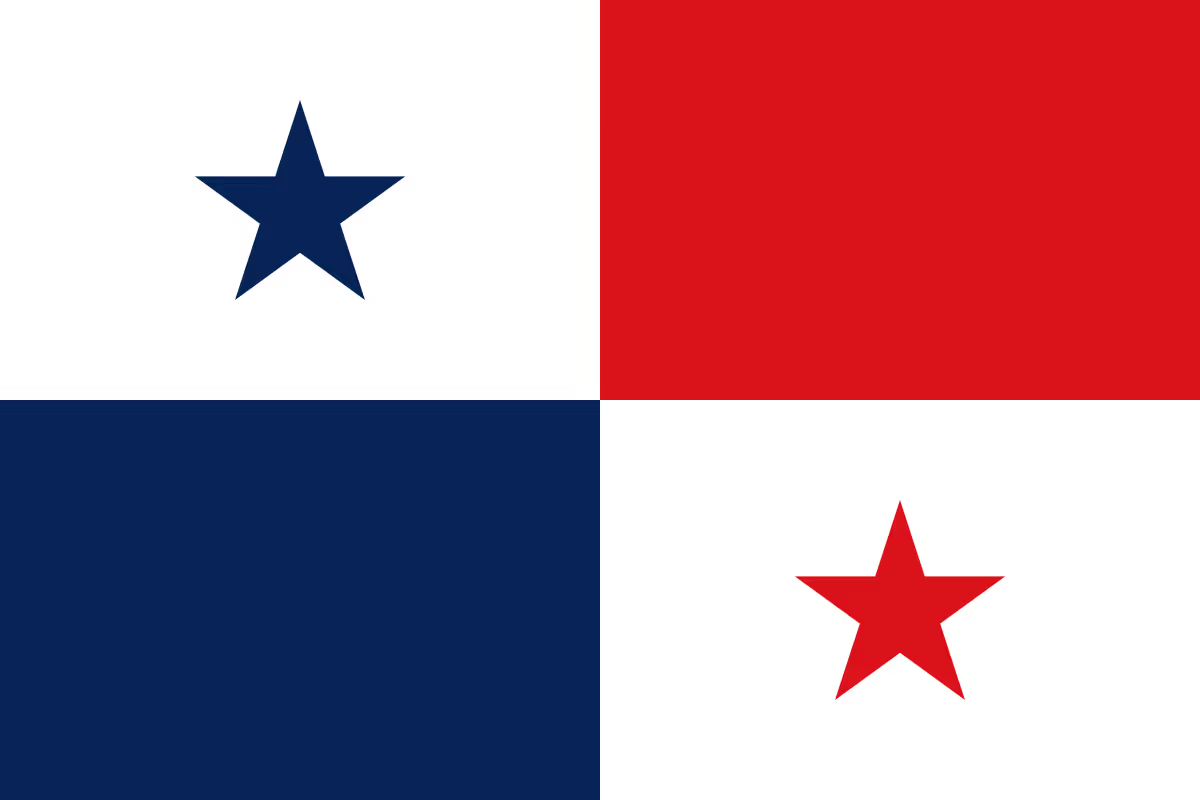





Key facts
| Regulator | Junta de Control de Juegos (JCJ), under the Ministry of Economy and Finance (MEF) |
|---|---|
| Legal basis | Decreto Ley No. 2 of 10 February 1998; Resolución No. 65 of 25 October 2002; Resolución No. 11 of 6 March 2020 (current online reglamento) |
| License structure | One Contrato de Administración y Operación, plus one Licencia de Juego per web domain, maximum five per contract (art. 16) |
| Government fee | B/.50,000 Derecho de Llave per Licencia de Juego (art. 12) |
| Bonds | B/.500,000 performance bond (art. 13) and B/.100,000 annual prize-payment bond (art. 14) |
| Revenue share to the JCJ | 10% of gross income (ingresos brutos), paid monthly within the first 10 calendar days (art. 15) |
| Contract term | Capped at seven years by art. 22 of Resolución No. 65 of 2002, conditional on fees being current; status under the 2020 reglamento unconfirmed |
| Minimum capital | No fixed floor. Working capital is whatever the approved business plan sets out (art. 10, Resolución No. 65 of 2002) |
| Local presence | Offices and a call centre in Panama are mandatory (art. 29.2) |
| Servers | May sit outside Panama, with exact location declared and a Certificado de Cumplimiento filed (art. 29.3) |
| Verticals covered | Sports events, including auto and greyhound racing, and internet casino games: poker, blackjack, roulette, slots (art. 16) |
| Excluded | Horse racing, lottery and similar games (art. 29.4) |
| Domain requirement | The domain must carry Panama's ccTLD, currently ".pa" (art. 31.c) |
| Since May 2026 | Law 527 of 23 May 2026 adds biometric player verification, site-blocking powers and fines of B/.25,000 to B/.100,000 |
Panama licenses online gaming through the Junta de Control de Juegos (JCJ), the national regulator sitting under the Ministry of Economy and Finance (MEF). Panama regulates the sector as "los Juegos de Suerte y Azar y las Actividades que Originan Apuestas", games of chance and activities that give rise to betting. Online operators have been licensed here since 2002.
The permit is normally held by a Panamanian Sociedad Anónima, and the current rules sit in Resolución No. 11 of 6 March 2020, which replaced the online provisions of Resolución No. 65 of 2002.
Two things about Panama are widely misreported and both matter to your budget. The government fee is set per web domain, not per company, and the JCJ takes 10% of gross income on top of it. The figures circulating on comparison sites, "$40,000 upfront and $20,000 a year", come from the 2002 text that the 2020 reglamento replaced. Everything below is cited to the article that sets it.
Panama gaming license vs gambling license: is there a difference?
No. A Panama gaming license, a Panama gambling license, a Panama casino license and a Panama iGaming license all name the same instrument. The JCJ works from one umbrella term, "los Juegos de Suerte y Azar y las Actividades que Originan Apuestas", which covers games of chance and betting activities together.
The wording splits by market habit, not by law. British operators say gambling, American operators say gaming, affiliates say iGaming. Panama issues one set of instruments for all of it: a Contrato de Administración y Operación, then a Licencia de Juego per domain. For how license types compare across jurisdictions, start at our gambling license hub.
Who regulates gaming in Panama?
The Junta de Control de Juegos (JCJ) regulates gaming in Panama. The JCJ operates under the Ministry of Economy and Finance (MEF) and handles licensing, supervision and enforcement. Decreto Ley No. 2 of 10 February 1998 restructured the JCJ. Resolución No. 65 of 2002 opened online licensing, and Resolución No. 11 of 6 March 2020 is the current reglamento.
What the JCJ controls in practice:
Approves the Contrato de Administración y Operación through its Pleno, on the Director's recommendation (arts. 9 and 11)
Issues each Licencia de Juego by resolución motivada, and can cancel a license if the site does not launch within three months (art. 16)
Vets individuals through Certificados de Idoneidad for directors, officers, shareholders and employees of trust (art. 18)
Approves the operator's Manual de Procedimientos de Control Interno and any later changes to it (arts. 32 and 35)
Maintains the Lista de Exclusión that operators must check before opening a player account (art. 36.b)
Orders blocking of sites, applications, domains and IP addresses of unlicensed operators, a power widened by Law 527 of 2026
One point that catches operators from lighter-touch jurisdictions: the Contraloría General de la República must countersign the contract before the government fee falls due (art. 12). That is a second state body in your critical path, not a formality inside the JCJ.
What activities does the Panama license cover?
Each Licencia de Juego covers betting on sports events, including auto and greyhound racing, and internet casino games: poker, blackjack, roulette and slots (art. 16). Horse racing, lottery games and games of a similar nature are excluded outright (art. 29.4). One license covers one web domain, with a maximum of five per contract.
Covered:
Sports betting on sporting events
Auto racing and greyhound racing
Poker
Blackjack and table games
Roulette
Slot machines and RNG games
Not covered:
Horse racing, excluded by art. 29.4
Lottery games and games of similar nature, excluded by art. 29.4
Bingo as an online vertical. Bingos appear in the reglamento only as physical venues where payment vouchers may be redeemed under a Contrato de Servicios (art. 30)
Comparison pages that list bingo, lottery and skill games under a single Panama license are describing something the reglamento does not authorise. If any of those verticals is core to your product, raise it before you file, because the answer changes your jurisdiction choice.
Who is the Panama gaming license suitable for?
A Panama gaming license fits established operators serving Latin America who can fund a B/.500,000 performance bond and staff a local office. Panama is not an entry-level jurisdiction. Startups comparing Panama with Anjouan on headline fees are comparing instruments with very different capital demands.
Good fit:
Operators targeting Latin America who want a Spanish-speaking regulator in a nearby time zone
Established groups that can post B/.500,000 in performance bonding plus a B/.100,000 annual prize bond
Businesses running sportsbook and casino together, which one Licencia de Juego covers
Operators who can staff offices and a call centre in Panama and accept a ".pa" domain
Poor fit:
Startups on a first license, where the bonding alone exceeds the entire budget for an Anjouan route
Operators needing EU or UK market access, where only a European license answers
Anyone planning to accept US players
Products built on bingo, lottery or horse racing, which the reglamento excludes
Operators who cannot absorb 10% of gross income as a monthly payment to the regulator
How it works
How do you get a Panama gaming license?
Navigating the gaming license process can be complex. Here's a streamlined guide to each step.
Getting a Panama gaming license runs through five stages: scoping and documents, forming the company, filing with the JCJ, investigation of every shareholder and director, then approval by the Pleno followed by the Contraloría countersignature and payment of the Derecho de Llave. Company formation and licensing run in parallel.
Resolución No. 11 of 2020 sets no statutory processing deadline, so treat any fixed promise of a license date with suspicion. Plan in months, not weeks: the fit-and-proper investigation reaches ten years of history for every shareholder and director, and the Contraloría refrendo sits outside the JCJ's control. We give you a project timeline against your own structure rather than a marketing figure. Ask for a Panama project timeline
What are the requirements for a Panama gaming license?
A Panama gaming license requires a Panamanian or Panama-registered company, offices and a call centre in Panama, ten-year fit-and-proper clearance for all shareholders and directors, five years of gaming experience at the top, certified gaming software from a registered provider, and a ".pa" domain.
Corporate and personnel:
A company constituted in Panama or registered as a foreign company with the Public Registry (art. 7.4)
Objects clause and share-transfer wording in the specific form art. 7(g) requires
Offices and a call centre in the Republic of Panama, holding the documentation the reglamento requires (art. 29.2)
A legal representative in Panama (art. 7.2)
Five years of gaming-industry experience in the majority shareholder or the president (art. 6)
Certificados de Idoneidad for directors, officers, shareholders and employees of trust (art. 18); Credenciales de Trabajo for staff (art. 24)
AML and KYC compliance under Ley No. 23 of 2015 (art. 29.6)
Documents you provide:
Passports or identity documents for all individuals
Ten-year personal, criminal, commercial and financial histories
Evidence of the source of financing for the proposed operation
Audited profit and loss accounts for the three previous fiscal years
Income tax returns for the three previous fiscal years
Certifications from the company secretary on shareholders, loans, encumbrances and the ten highest-paid individuals
Documents we build:
Internal control procedures manual, which the Director must approve (art. 32)
AML and KYC policy set
Responsible gaming programme aligned to the JCJ-approved logo and materials
The corporate file and apostilled document set
Technical and operational:
The gaming system must be registered and bought from a provider registered with the JCJ (art. 29.5)
Random number generation must be certified, and theoretical return to player must not fall below 80% (art. 69)
Certificates of compliance come from an Entidad Autorizada, meaning a national or foreign body registered with the JCJ for that purpose. The reglamento names no laboratory, so treat GLI, BMM Testlabs and eCOGRA as market practice rather than a JCJ list
Servers may be located outside Panama, provided the exact location is declared and a Certificado de Cumplimiento is filed in either case (art. 29.3)
The website must show the operator's Panama head-office address and telephone, the JCJ responsible gaming logo, a complaints icon linked to a JCJ email address, and the domain must carry the ".pa" ccTLD (art. 31)
One player account per person, checked against the JCJ Lista de Exclusión, opened with between B/.20 and B/.10,000, valid for two years (art. 36)
An external auditor's report on the internal control manual, filed within 90 calendar days of fiscal year end (art. 34)
The local presence rule and the server rule are often reported as if they conflict. They do not. The company needs a physical office and call centre in Panama; the technical platform can stay where it is, as long as its location is declared and certified.
How much does a Panama gaming license cost?
Resolución No. 11 of 2020 sets a Derecho de Llave of B/.50,000 for each Licencia de Juego, a performance bond of B/.500,000, and an annual prize-payment bond of B/.100,000. The JCJ then takes 10% of gross income monthly. Panama is a bonded jurisdiction, and the bonding dominates the entry cost.
Panama government fees and bonds
| Item | Amount | Basis | When |
|---|---|---|---|
| Derecho de Llave | B/.50,000 per Licencia de Juego | Art. 12 | After the Contraloría countersigns the contract; on approval of each further license |
| Performance bond (fianza de cumplimiento) | B/.500,000 | Art. 13 | On grant of the Contrato de Administración y Operación |
| Prize-payment bond (fianza de pago de premios) | B/.100,000 | Art. 14 | Before operations start, maintained and presented every year |
| Revenue participation | 10% of gross income (ingresos brutos) | Art. 15 | Monthly, within the first 10 calendar days |
| Late payment surcharge | 1% per month on the amount due | Art. 15 | On any late revenue payment |
| Work credential processing | B/.50 per person | Art. 25.e | Per staff credential application |
The fee chapter of Resolución No. 11 of 2020 contains these charges and no flat annual license fee. The "$20,000 a year" figure quoted across comparison sites comes from art. 21 of the 2002 text, which set a US$20,000 annuality per Panama gaming license before the 2020 reglamento restructured the fee provisions. Confirm with the JCJ whether any annuality survives alongside the 10% revenue participation.
Two cautions on these figures. The B/.50,000 is charged per Licencia de Juego, so a five-domain operation carries five charges, not one. And "ingresos brutos" means gross income; the reglamento does not define whether that is total stakes or stakes net of winnings, and the difference is very large. Confirm the base with Panamanian counsel before you model revenue, because a 10% charge on turnover and a 10% charge on gross gaming revenue are different businesses.
Beyond the state figures, budget for the company and its registered agent, the Panama office and call centre, software certification, the compliance function, the external audit, and legal filing work. We quote the full first-year outlay against your structure, domain count and verticals. Get a Panama cost breakdown for your structure
Renewal cost
The recurring obligations that Resolución No. 11 of 2020 fixes are the B/.100,000 prize-payment bond, which must be maintained and presented to the JCJ every year (art. 14), and the monthly payment of 10% of gross income (art. 15). Missing the monthly payment adds a 1% monthly surcharge.
Arrears of three months are grounds for an Orden de Emergencia or rescission of the contract (art. 15). Alongside the bond, the annual cycle includes the external auditor's report on the internal control manual, due within 90 calendar days of fiscal year end (art. 34). Renewal is a live compliance review, not a payment.
What taxes apply to a Panama gaming license?
A JCJ licensee pays 10% of gross income to the Junta de Control de Juegos every month under art. 15 of Resolución No. 11 of 2020. Resolución No. 65 of 2002 treats operating income as foreign-source and exempts it from income tax and dividend tax, but it carves out payments owed to the JCJ. The 10% is not exempt.
Art. 21 of Resolución No. 65 of 2002 sets the mechanism out plainly: bets may not be taken from within Panama, income from operating the systems counts as foreign-source income, and, other than payments corresponding to the Junta de Control de Juegos, that income is not subject to income tax, dividend tax or revenue participation. The exemption is conditional on the operation facing outward, and it never covered the regulator's own charge.
Two figures in wide circulation are wrong. The "4% on local revenue" attributed to Panama is not a gaming tax at all: Panama's corporate regime carries a 25% rate plus an alternative minimum calculation of 4.67% of gross taxable income for larger companies, which is where that number originates. And "no taxes on foreign revenue" describes the income tax position only, while ignoring the 10% the regulator takes first.
One question we flag rather than paper over. The 2002 reglamento barred Panama residents from using these systems, while Resolución No. 11 of 2020 requires a ".pa" domain and a call centre in Panama. Whether the 2020 rules opened any domestic play, and what that does to the foreign-source analysis, needs an opinion from Panamanian tax counsel on your own structure.
Panama also appears on the EU list of non-cooperative jurisdictions for tax purposes. That does not change your Panamanian liabilities and does change how European banks and acquirers price you. Ask us to model the Panama tax position
What is Bill 403 (now Law 527) and how does it affect Panama operators?
Bill 403 is no longer a bill. It was promulgated as Law 527 of 23 May 2026 and published in the Gaceta Oficial on 28 May 2026, as a problem-gambling measure regulating betting on digital platforms, mobile applications, websites and electronic systems. The Executive has six months from promulgation to issue implementing regulations, which points to around November 2026.
What reporting on the enacted law establishes:
Biometric identity verification of players, extending to online platforms, physical casinos and digital payments
Mandatory spend and time limits for players, with automatic alerts on risk patterns
Power for the JCJ to order blocking of websites, applications, domains and IP addresses of unlicensed operators, executed through telecom providers
Fines of B/.25,000 to B/.100,000, doubling on repeat breach, plus temporary suspension or definitive cancellation of the license
Fines up to B/.1,000,000 for operating without a license
A mental health prevention fund for the Instituto de Salud Mental (INSAM), financed from operator contributions and administered by the MEF. Reported rates conflict, so we are not publishing one until the Gaceta text is read
A minimum age of 18, and prevention content in schools through the health and education ministries
Three points where published summaries are unreliable.
The INSAM contribution is widely repeated as 10% of profits, which was the March bill's wording. Reporting on the enacted law describes a far smaller contribution routed through the MEF instead. Both cannot be right, so we treat the rate as unconfirmed.
Penalties in the enacted law are fixed balboa bands, not "up to 10% of revenue".
The advertising ban, payment-method limits and real-time monitoring the March bill carried are not confirmed in reporting on the final text, so we do not present them as current Panamanian law.
For an operator the practical read is this: budget for biometric onboarding and player-limit tooling before the implementing regulations land, and treat the blocking power as the real enforcement change. Law 527 raises the compliance floor rather than the tax bill. We are watching for the reglamento and the Gaceta text. Ask how Law 527 affects your Panama plan
Can Panama-licensed operators access global markets?
A Panama gaming license grants no access to regulated markets. The license authorises operation from Panama; whether a given country's players may lawfully be accepted is decided by that country's law. The reglamento is explicit in the other direction too: a license from another jurisdiction confers no right to operate in Panama (art. 2).
Enforcement against Panama-based operators is not theoretical. On 28 April 2025 the Michigan Gaming Control Board issued cease-and-desist orders to SportsBetting.ag and BetOnline.ag, describing them as Panama-based, giving 14 days to stop serving Michigan residents and citing the Lawful Internet Gaming Act, the Gaming Control and Revenue Act and the Michigan Penal Code.
Two consequences to plan for:
Geo-blocking has to work, not merely exist. Every market you cannot lawfully serve needs a block that holds up to inspection, and Law 527 gives the JCJ its own blocking power over unlicensed sites.
Banking carries extra scrutiny. Panama's AML history and its EU non-cooperative listing mean acquirers price Panamanian gaming companies above a Malta-licensed equivalent, and some decline the category.
"Global reach" in marketing copy means the license has no territorial limit written into it. It does not mean lawful market access. Treat any adviser who blurs those two as a warning sign.
Own Panama license vs white-label
Holding your own Panama license means a direct Contrato de Administración y Operación with the JCJ: the permit, the player data and the enterprise value sit with you. Panama also recognises a middle route, the Operador Designado, where a license holder authorises another company to use and exploit a Licencia de Juego under a contract the Director approves (art. 17).
Own Panama license, Operador Designado and white-label
| Factor | Own Panama license | Operador Designado under art. 17 | White-label elsewhere |
|---|---|---|---|
| Relationship with the JCJ | Direct contract holder | Authorised user of another holder's license, approved by the Director | None |
| Regulatory approval needed | Full application and investigation | Director's authorisation, and arts. 5 and 6 still apply to you | Provider's license covers you |
| Player data | Yours | Governed by the contract | Provider's, with contractual access |
| Enterprise value on exit | License and data are sellable assets | Limited, the license is not yours | Limited |
| Entry cost | B/.50,000 per license plus B/.600,000 in bonding | Negotiated with the holder | From USD 15,000 |
| Time to launch | Months | Shorter than a full application | 2 to 6 weeks |
| Ongoing economics | 10% of gross income to the JCJ, plus fixed bonds | Contractual, plus the holder's regulatory costs | Revenue share up to 30% |
The Operador Designado route is the part of Panama's framework most comparison pages miss, and it is genuinely useful: art. 17 still puts you through the fit-and-proper tests of arts. 5 and 6, so it is not a way around due diligence, but it removes the bonding and the Derecho de Llave from your entry cost.
White-label first and your own license later is a legitimate sequence for testing whether a market works. It stops being right once revenue share on a growing book exceeds the fixed regulatory cost. Detail on both routes: white-label online casino solutions.
How does Panama compare with other gaming licenses?
Panama is the most heavily bonded of the offshore options, at B/.600,000 in bonds plus B/.50,000 per domain and 10% of gross income. Anjouan and Costa Rica cost a fraction of that, Curaçao carries a high annual fee instead of bonds, and Malta charges less at entry than Panama bonds but takes about a year.
Panama against four alternatives
| Jurisdiction | Government cost | Gaming charge | Local presence | Time to license | Standing with banks |
|---|---|---|---|---|---|
| Panama | B/.50,000 per license per domain, plus B/.500,000 and B/.100,000 bonds | 10% of gross income, monthly | Offices and call centre in Panama | Not fixed by the reglamento; plan in months | Mid-tier; EU non-cooperative listing counts against it |
| Anjouan | From EUR 17,828 government fee | 0% | None | From 4 weeks, typically 6 to 8 | Entry-level, thinnest of the five |
| Curaçao | EUR 4,592 application plus EUR 150 per UBO, then EUR 47,450 a year for B2C | 0% gaming tax | Local company, office, resident key person | 3 to 6 months | Recognised offshore brand, costly since the 2024 reform |
| Costa Rica | From USD 6,500, then from USD 5,000 a year | 0% on offshore income | Company, office and servers in Costa Rica | 5 to 6 weeks | No gaming regulator at all, which some acquirers reject |
| Malta | EUR 5,000 application plus EUR 25,000 a year, plus compliance contribution from EUR 15,000 | 5% on Maltese revenue only, rising to 15% for Type 1 and 10% for Types 2 to 4 from 1 October 2026 | Local company and substance | About 12 months | Strongest of the five, EU-regulated |
Figures are stated in the currency each regulator sets and collects, with no exchange rate applied. The Panamanian balboa is pegged to the US dollar at 1:1. Costa Rica is included for comparison but issues no Costa Rican gaming license at all: operators there hold a data processing license, a different instrument.
Read the table by constraint, not by price. If tier-1 European banking decides your business, Malta is the only column that answers. If speed and cost decide it, Anjouan wins and Panama does not compete. Panama earns its place when you want a national Latin American regulator with a real rulebook, and you have the balance sheet to post the bonds.
Advantages of a Panama gaming license
Panama offers a genuine national regulator with a detailed published rulebook, one license covering sportsbook and casino together, up to five domains under a single contract, servers permitted outside the country, no residency requirement on directors, and a framework that has licensed online operators since 2002.
Sportsbook and casino sit under the same Licencia de Juego, so a dual-vertical operator files one application
The rulebook is public and specific, down to player account rules and website requirements, which shortens compliance arguments with payment providers
Servers may stay outside Panama, so existing hosting can remain in place (art. 29.3)
Directors and shareholders may hold any nationality, with no residency requirement on individuals
A Spanish-speaking regulator in a Latin American time zone, which matters if LATAM is your market
The Operador Designado mechanism in art. 17 offers a licensed route to market without the full bonding
Up to five domains under one contract, useful for multi-brand operators (art. 16)
No fixed minimum capital. Working capital is set by the business plan the JCJ approves, not by a statutory floor
Panama uses the US dollar alongside the balboa at parity, which removes currency friction from fee planning
Disadvantages of a Panama gaming license
Panama's drawbacks are capital and reputation. Bonding of B/.600,000 puts it beyond most first-time operators, the JCJ takes 10% of gross income monthly, the license opens no regulated market, and Panama's AML history plus its EU non-cooperative listing raise the price of banking.
B/.500,000 performance bond and B/.100,000 annual prize bond, which together exceed the whole cost of several offshore alternatives
10% of gross income paid monthly to the JCJ, against 0% in Anjouan, Curaçao and Costa Rica
The Derecho de Llave is charged per domain, so multi-brand plans multiply the fee
No market access. The license permits operation and opens nothing, and US-facing traffic draws enforcement
Bingo, lottery and horse racing are excluded, which rules Panama out for some products
Offices and a call centre in Panama are mandatory, a real operating cost that Anjouan does not impose
A ".pa" domain is required, which constrains brand and SEO plans built on a .com
Five years of gaming experience is required at shareholder or president level, which blocks some first-time entrants
Tier-1 banks apply extra AML scrutiny, and player trust sits below Malta and the UK
MGL publishes this list because operators who discover these after posting a bond become former clients. If the bonding or the excluded verticals are fatal for your plan, the honest answer is a different jurisdiction. Ask which jurisdiction fits your model
Why choose MGL Solutions for a Panama license?
MGL Solutions has obtained 300+ licenses across offshore, onshore and EU jurisdictions. On Panama we work from the reglamento itself rather than from recycled comparison tables, which is why our cost model includes the bonding and the 10% revenue participation that most published Panama figures leave out.
We run the company, the JCJ filing, the internal control manual and the banking approach as one project, so nothing falls between a corporate agent and a gaming lawyer
We check your shareholders against the ten-year fit-and-proper standard before the JCJ does, so problems surface while they are still fixable
We structure around the real constraints, including the art. 6 experience requirement and the Operador Designado alternative when full bonding does not fit
Payment and banking introductions through a vetted network, supported by an external payments specialist with 8+ years in high-risk processing
We work directly across all license types, offshore through EU tier-1, so our jurisdiction advice is not steered by what we can sell
Post-license support on the monthly revenue filings, the annual bond, the external audit and Law 527 readiness, where most of the real work sits
FAQ
Everything you need to know about Our company. Can't find the answer you're looking for? Please chat to our team.
Yes. Gambling is legal and regulated in Panama. Decreto Ley No. 2 of 10 February 1998 restructured the Junta de Control de Juegos (JCJ), Resolución No. 65 of 2002 opened online licensing, and Resolución No. 11 of 6 March 2020 is the online reglamento in force.
A Panama gaming license runs for the term of the Contrato de Administración y Operación, capped at seven years by art. 22 of the 2002 reglamento and conditional on fees being current. Whether Resolución No. 11 of 2020 kept that cap is unconfirmed, so verify the term in your contract.
No. A Panama gaming license confers no right to serve US players. On 28 April 2025 the Michigan Gaming Control Board issued cease-and-desist orders to two Panama-based operators, SportsBetting.ag and BetOnline.ag. Operators must geo-block the United States and every market they are not licensed to serve.
Resolución No. 11 of 2020 does not address cryptocurrency. Art. 29.7 limits prize payment to bank account deposits, credit cards, other methods the banking system permits, and voucher redemption at approved venues, which does not contemplate crypto payouts. Confirm any crypto model with the JCJ before launch.
Yes. Foreign owners hold a Panama gaming license through a company constituted in Panama or registered as a foreign company with the Public Registry. Directors and shareholders may be of any nationality with no residency requirement, and the ten-year fit-and-proper investigation applies regardless of nationality.
Yes. Art. 29.2 of Resolución No. 11 of 2020 requires the operator to have offices and a call centre in the Republic of Panama, holding the documentation the reglamento requires. Gaming servers may sit outside Panama if the exact location is declared and a Certificado de Cumplimiento is filed.
The Junta de Control de Juegos (JCJ) is Panama's national gaming regulator, operating under the Ministry of Economy and Finance (MEF). The JCJ awards operating contracts and gaming licenses, vets individuals through Certificados de Idoneidad, audits licensees, and enforces breaches through fines, suspension or cancellation.
Law 527 of 2026 sets fines of B/.25,000 to B/.100,000, doubling on repeat breach, plus suspension or cancellation of the license, and up to B/.1,000,000 for unlicensed operation. Three months of arrears on the monthly revenue payment can trigger rescission of the contract under Resolución No. 11 of 2020.
Heading: Get the real Panama numbers before you commit
Body: Panama charges per web domain, plus B/.600,000 in bonds and 10% of gross income monthly. Send us your verticals and markets, and we will tell you what it costs you.
Panama charges per web domain, plus B/.600,000 in bonds and 10% of gross income monthly. Send us your verticals and markets, and we will tell you what it costs you.